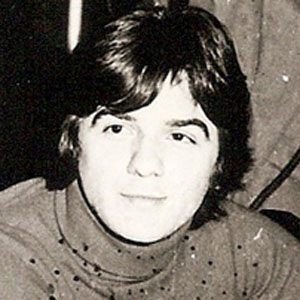
| Name: | Zdravko Colic |
| Occupation: | Pop Singer |
| Gender: | Male |
| Birth Day: | May 30, 1951 |
| Age: | 74 |
| Birth Place: | Sarajevo - Bosnia And Herzegovina |
| Zodiac Sign: | Gemini |
| DOB in Roman: | V.XXX.MCMLI |
Zdravko Colic
Zdravko Colic was born on 30 May 1951(74 years old) in Bosnia And Herzegovina. Zdravko Colic is Pop Singer, Zodiac sign - Gemini. More detail about Zdravko Colic given below.
About Zdravko Colic
Pop singer who won the Eurovision Song Contest in 1973 with his smash song"Gori vatra". In 1975, he released his debut solo album, Ti I Ja (You and I), followed by the even more popular album Ako Prides Blize (If You Come Closer).
Trivia
He started Ambassadori, a rhythm and blues band that performed covers as well as original music.
Zdravko Colic before fame
He used to sing and play guitar in neighborhood parks when he was younger. He rose to prominence after winning a singing competition in Biejela.
Achievement of Zdravko Colic
He established Ambassadori, a rhythm and blues band that performed both covers and original material.
Salary 2020
Not known
Net Worth 2020
$20 Million
Zdravko Colic family life
In 2001, he married Aleksandra. He's the father of two daughters.
Associations of Zdravko Colic
He came in second place in a singing competition by performing"Lady Madonna", a song penned by Paul McCartney and John Lennon.
Zdravko Colic Height, Weight & Physique Measurements
| Weight | in kg - N/A |
| Height | N/A |
| Eye Color | N/A |
| Hair Color | N/A |
Zdravko Colic Timeline
- 1967
His first significant public singing experience occurred in 1967, when he spent some time at the Montenegrin coast for the Republic Day. Staying in the house his father owned in the coastal community of Baou0161iu0107i, 17-year-old u010coliu0107 was persuaded by a friend, Nedim Idrizoviu0107, to enter the amateur signing competition in nearby Bijela. He won second prize singing "Lady Madonna" by The Beatles.
- 1969
Encouraged by this unexpected success, and soon after returning to Sarajevo, u010coliu0107 entered his first bandu2014a group called Mladi i lijepi. This engagement didnu0027t last, however, because around the time he graduated high school in 1969; he moved to the more established Ambasadori, a band whose two incarnations he would end up staying with for the next two and a half years.
- 1970
Seeing their opportunities limited by the strange situation, Vujoviu0107 and u010coliu0107 decided to step out and form Novi ambasadori in 1970, bringing in drummer Perica Stojanoviu0107, organist Vlado Pravdiu0107, saxophonist Lale Stefanoviu0107, and bassist Zlatko Hold. With the almost all new lineup, the band also expanded its repertoire so that in addition to R&B they now also played covers of Led Zeppelin, Blood, Sweat & Tears, Creedence Clearwater Revival, etc. In the summer of 1970, Novi ambasadori scored a month-long gig with Indexi in Dubrovnik, which was their first tour-like experience. Next step was competing at the 1971 Vau0161 u0161lager sezone annual festival in Sarajevo where they finished in 7th place with a song "Plau010dem za tvojim usnama" that songwriter Zdenko Runjiu0107 claimed to have composed and officially signed his name under, despite the fact that it was a blatant rip-off of The Tremeloesu0027 "Suddenly You Love Me" (which actually is a cover of Riccardo Del Turcou0027s "Uno tranquillo" ). No one from the festival noticed this plagiarism and the band avoided the controversy. The song was even released on a 7-inch single "Plau010dem za tvojim usnama" / "Zapjevaj" by Beograd Disk and sold surprisingly well. The performance at Vau0161 u0161lager sezone was also significant since it marked the bandu0027s first television appearance, exposing them to a much larger audience. One of the people in that TV audience was Kornelije Kovau010d, an already influential and established figure in Yugoslav music circles, who immediately was intrigued by u010coliu0107u0027s "clean tenor and good stage presence".
- 1971
On 10 September 1971, twenty-year-old u010coliu0107 left his hometown and moved to the capital Belgrade in order to join his new band. However, his stint with Korni grupa ultimately proved to be very short and largely unsuccessful as he never meshed well enough with the rest of the group musically, finding it hard to fit into their progressive rock style. He recorded three tracks with them, "Kukavica, "Gospa Mica gazdarica", and "Pogledaj u nebo", all of which were released on the 7-inch single by PGP RTB. Track "Gospa Mica gazdarica" managed to create minor controversy due to the slightly risque lyrics written from the perspective of a young man imploring his older female landlord to allow him into her bedu2014a nod to u010coliu0107u0027s life at the time since he was living away from home in sublet apartments. Due to numerous complaints, the song was taken off radio playlists.
- 1972
On 15 April 1972 u010coliu0107u0027s first solo move was taking part in the Vau0161 u0161lager sezone competitive festival in Sarajevo. He won the third audience prize as well as the interpretation award with Kemal Monteno written song "Sinou0107 nisi bila tu" that was originally meant to be sung by Josipa Lisac who opted out at the last moment.Right away, under Kovau010du0027s guidance u010coliu0107 managed to establish a fair amount of prominence as a solo actu2014and on 20 May 1972 the two appeared as guests on the very popular TV Belgrade variety show Obraz uz obraz hosted by Milena Draviu0107 and Dragan Nikoliu0107. The same year, u010coliu0107 made further appearances at the Split festival (with song "Stara pjesma"), Priu0161tina festival, and Skopje Festival (with song "Moj bol"), before embarking on a tour of Soviet Union together with Indexi, Bisera Veletanliu0107, Sabahudin Kurt, and Sabina Vareu0161anoviu0107.
- 1973
Then came the first big break that launched him on the road to stardom. By winning at the Opatija festival with song "Gori vatra" written by Kemal Monteno, u010coliu0107 got to represent SFR Yugoslavia at the 1973 Eurovision Song Contest on 7 April 1973 in Luxembourg. The song placed poorly, but became a well-respected hit at home.
- 1974
Riding the wave of exposure the Eurovision appearance afforded him, u010coliu0107 continued entering competitive festivals throughout SFR Yugoslavia over the next two years with plenty of success. At Hit parada festival in Belgrade on 23 November 1974, he won with the song "Ona spava", composed and written by Kornelije Kovau010d. Next year, 1975, u010coliu0107 bagged a few more festival wins with Kovau010du0027s songsu2014Beogradsko proleu0107e with "April u Beogradu", and Vau0161 u0161lager sezone with "Zvao sam je Emili". Other songs he performed at various festivals in those years were "Bling blinge blinge bling" (1973 Vau0161 u0161lager sezone, composed by Zdenko Runjiu0107), "Ljubav je samo rijeu010d" (1974 Beogradsko proleu0107e, composed by Vojkan Borisavljeviu0107), and "Zelena si rijeka bila" (1974 Vau0161 u0161lager sezone, composed by Kemal Monteno).
- 1975
His first solo album was Ti i ja (You and I), released in 1975 by Jugoton. Closely overseen by Kornelije Kovau010d, the album brought u010coliu0107 more hits like "Vagabund", "Igrau0161 se vatrom", and "Lou0161e vino" (written by Arsen Dediu0107 and Goran Bregoviu0107). Cover sleeve was done by Dragan S. Stefanoviu0107, another collaborator who would remain with u010coliu0107 for years to come. u010coliu0107u0027s image especially appealed to girls and women, something that would remain a staple of his entire career. The same year, cashing in on his sudden popularity upswing, PGP RTB released a compilation of his festival singles under the name Zdravko u010coliu0107.
- 1976
Despite, achieving great prominence already, u010coliu0107 continued appearing at the occasional festival such as the Zagreb one in 1976 where he surprisingly finished in fourth place singing "Ti si bila, uvijek bila". At the end of that year he went on a Yugoslavia-wide tour with Indexi. After the Belgrade concert, the measure of his sudden fame was on public display during autograph-signing at the Jugoton store as the cordon of girls rushed the store, breaking a window glass in attempt to get closer to him.
- 1978
On 1 April 1978, he started an ambitious tour of SFR Yugoslavia with Lokice dance group in support of the album that had already sold 150,000 copies. u010coliu0107 also started to play the guitar occasionally on stage. Putujuu0107i zemljotres (Traveling Earthquake Tour) produced and organized by Maksa u0106atoviu0107 moved all over the country, soon becoming a phenomenon the likes of which the country had not seen before. The scenes of screaming girls rushing the stage were repeated in a city after a city. The touru0027s climax took place in Belgrade at Red Star FC stadium on 5 September 1978 with 70,000 people in attendance despite the fact that u010coliu0107 already played two sold-out shows in Belgrade a few months earlier on 4 and 8 April at Hala Pionir. Supporting u010coliu0107 on stage that night were Chris Nicholls on keyboards and Dado Topiu0107 on bass guitar, with old favourites Kornelije Kovau010d, Arsen Dediu0107, Kemal Monteno, Josip Bou010dek, Trio Strune, and RTV Belgrade singing quintet appearing as guests. u010coliu0107 and the great tour essentially became a cultural phenomenon transcending musical boundaries such that in the lead-up to the big Belgrade concert journalist Duu0161an Savkoviu0107 and film director Jovan Ristiu0107 decided to make a movie about u010coliu0107. Savkoviu0107 wrote a rudimentary screenplay, but the movie ended up being a 90-minute feature documentary titled Pjevam danju, pjevam nou0107u that follows u010coliu0107 from Belgrade concert onwards and looks back on his career up to that point. Two days after the Belgrade concert, u010coliu0107 was in his hometown Sarajevo at Kou0161evo Stadium for the touru0027s grand finale; however, the rain interrupted much of the concert. By the end of its promotion cycle, the album sold more than 700,000 copies and with later re-releases during the 1990s went over the million mark.u010coliu0107 also got the attention of Ziggy Loch, director of German WEA, who immediately after watching the Belgrade concert wanted to renew his contract. Singles with songs "Jedina" and "Zagrli me" were released for the German market as well as the disco single "Iu0027m Not a Robot Man" / "Light Me". However, u010coliu0107 refused to move to Germany for the second time, and instead on 14 November 1978 went to serve his mandatory Yugoslav Army stint. Twenty seven years of age at the time, u010coliu0107 was assigned to a unit in Valjevo, before getting transferred to Belgrade, and finally Pou017earevac. After serving 10 months, he got out of the military service on 14 September 1979.
- 1984
In 1984, u010coliu0107 moved from his hometown Sarajevo to Ljubljana where he started a private business with Goran Bregoviu0107 through their Kamarad label. He then lived in Zagreb for five years. 1988 saw his hit "Jastreb". In 1989, he moved back to Belgrade.
- 1990
After his 1990 album "Da ti kau017eem u0161ta mi je", he didnu0027t make another album until late 1997, when he embarked on a comeback with Komuna label album Kad bi moja bila, and regained much of his popularity. The following year, u010coliu0107 had nine sold-out concerts at Sava Centar.
- 2005
In October 2005, he performed two concerts at the Belgrade Arena.
- 2010
In 2010, he had a big concert on the Asim Ferhatoviu0107 Hase Stadium in Sarajevo, within his Kad pogledau0161 me preko ramena tour, in front of over 60,000 people. On 25 June 2011, he had the biggest concert of his career: on Uu0161u0107e, in Belgrade, with over 100,000 visitors. His biggest concert to date, it celebrated his 40-year career milestone.
| 🎂 Zdravko Colic Next B'Day Count Down - | |
|---|---|
| 2026-05-30 : 3s |